
Martha Ullman West
Thank you

The beautiful, vivacious, wise, loving, sharp-eyed and sharp-witted Martha Ullman West passed away last weekend at the age of 88.
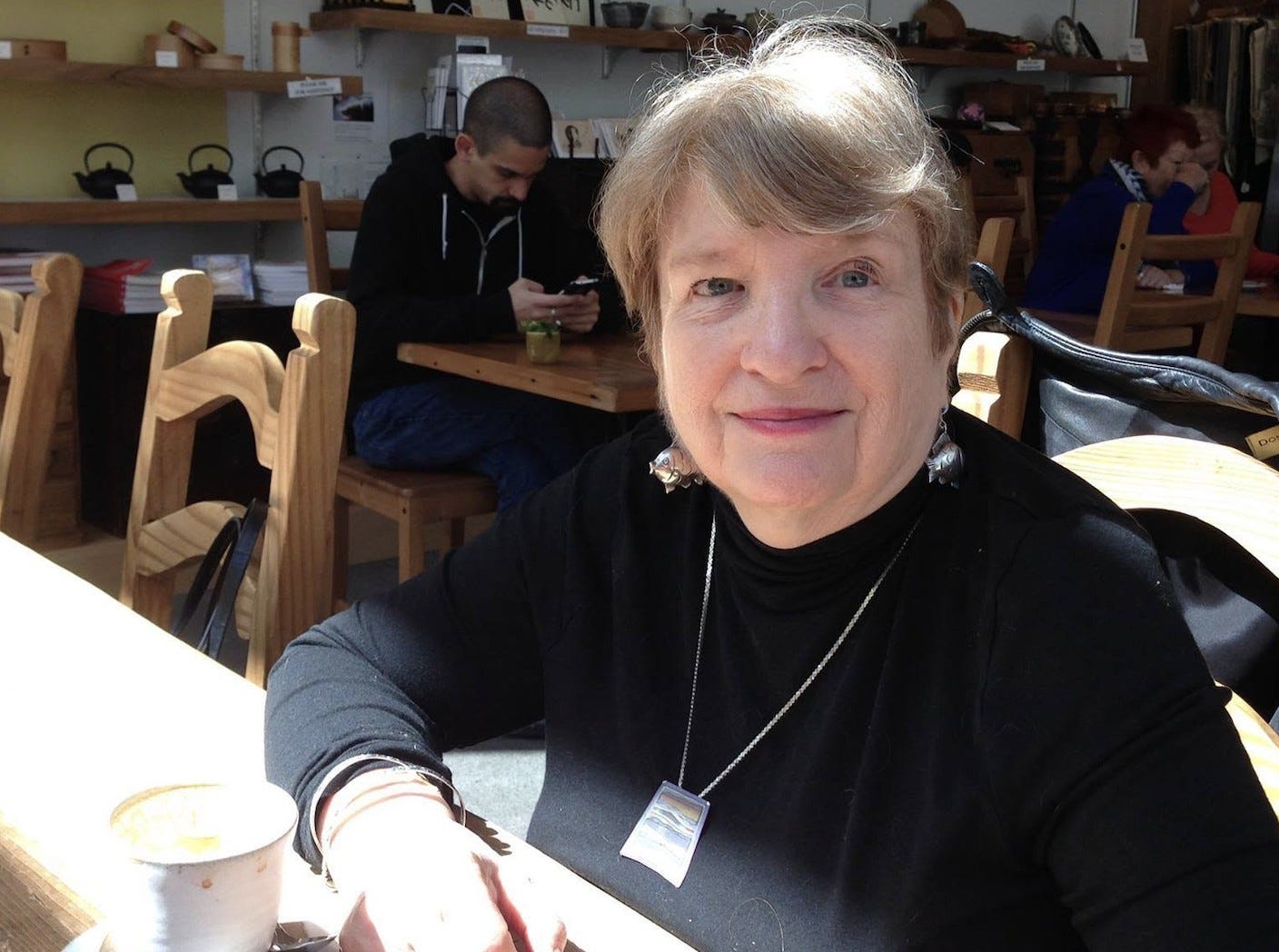
Sometime in early spring or late winter of 2010, Martha invited me over to her stately house in southeast Portland. She’d been assigned (or volunteered? I’ll never know) to write my “exit story” for Dance Magazine, as I was about to retire from Oregon Ballet Theatre. Martha and I’d already known each other for several years, since the first time she interviewed me when I was brand new in town and had just joined OBT. We’d been friendly over the years, but I was still a bit surprised when she suggested I come over to her house to chat over cocktails instead of setting up a phone call or meeting at the OBT studios. But I was certainly taking my cues from her, so I readily agreed. When I arrived at her large, classically SE Portland home with a lovely porch and leafy front yard, Martha ushered me in, told me she was having Ketel One on the rocks and asked what I wanted— wine, a cocktail, seltzer (we’re both New Yorkers)? Her eyes, when I asked for bourbon, widened a bit in surprise but also glinted with approval.
We settled into her living room. Instead of a set of questions, Martha seemed to just want to talk— about life, dancing, not dancing, growing up in New York (we bonded over our shared hometown), ballet history (she took me upstairs to see an old video of Lew Christensen’s ballet Filling Station), and who knows what else. At one point, trying to make sense of why I had no husband, mate, or children and couldn’t even come up with a colorful description of how I spent my weekends, she asked, “Well, Gavin, are you a nun?” “No— I’m not even Catholic!” I replied, getting a laugh out of her for the first time and, I think, solidifying our friendship.
Martha was— and will always be— legendary. As a devoted Dance Magazine reader, I knew of her and had read her work long before we first met in person, which was not long after I’d joined Oregon Ballet Theatre in 2003. Christopher Stowell was OBT’s new artistic director, and I assumed that when I was asked to come in early one morning to for an interview, it would be about the transitional era that OBT and I were entering.
But when we sat down at the round table in OBT’s lobby, the first thing Martha asked was, “How does it feel to be entrusted with carrying on Balanchine’s legacy?” Gulp! I was caught off guard, but also excited— now this was going to be an interesting interview.
I can’t remember the piece Martha wrote from that interview, but the fact that instead of writing what could have been another boilerplate story on a ballet company’s change of directorship, she led with the issue of choreographic lineage and the dancer’s unique role as a creative interpreter was classic Martha-style. Over decades of watching, thinking, questioning and writing about dance, she had a way of bringing the big picture into focus by drawing our attention to the details that defined it. Also classic Martha was her emphasis on the significance of history, the un-severable lines linking dancers and the things they dance from yesterday through today and into tomorrow. She wanted us all to remember that the past lives forever, in choreography, teaching, and performance. And in the people who carefully pass it along, hand to hand.
Martha and I hit it off. At some point after our cocktail interview (and once I was no longer the subject of her reviews), we started occasionally getting together for cocktail hour, where she’d amaze me with stories about her life, her childhood in Greenwich Village, the multitudes of artists and intellectuals she’d met and hobnobbed with and written about (she was Margaret Mead’s goddaughter) and also lots of chitchat and, yes, gossip, about the ballet world today— and yesterday, and forecasting tomorrow. As incredibly wise about and steeped in dance as she was, Martha wasn’t above asking questions to deepen her understanding of an art form she’d never practiced herself. She genuinely wanted to hear my thoughts and ideas about what it’s all about from the dancer’s point of view. Like many of our exchanges, one particularly memorable conversation happened over email (lots and lots and lots of emails went back and forth between us, as I know they did between her and her many close friends around the country). She was writing about the concept of the “Balanchine ballerina” and wanted to know what I thought made someone qualify. I was in the Portland airport waiting for a flight while we exchanged near-simultaneous messages, which unfortunately I can’t find now, but I do remember telling her that I thought “ballerina” was a slippery, overused and misunderstood term, but in any case, I thought that a Balanchine one was more attuned to the music than anything else. She called me “Ms. Smarty-Tights” after that, which I took as a very high compliment.
As anyone who ever met her knows (and as a critic has to be) Martha was opinionated and very un-shy and blunt— but elegant— when sharing those opinions. As both her friend and the subject of some of her reviews, I wondered how she managed to separate her critical eye and her understanding of a dancer’s offstage persona. But I came to see that her knowledge of who a dancer was made her critiques extra astute. I had learned not to overly interpret reviews of my performances, especially during a run, but I did read one of Martha’s reviews of me the afternoon before a show of Balanchine’s Emeralds. It was less than glowing, and I knew she was right.
To me, Martha was a friend, a mentor, a mom-figure. After I retired from performing and started teaching and writing, we got together more and more often and exchanged more and more email. She offered me loads of advice, words to the wise, cautions, reminiscences from her own life and from history, but was always, always encouraging, dryly hilarious, realistic and warm, even when the state of the world seemed bleak (the National Guard presence in Portland rattled her deeply, since by then she’d moved to an apartment downtown and heard every helicopter flying low over her building). She was writing her joint biography of Janet Reed and Todd Bolender, “Todd Bolender and Janet Reed, and the Making of American Ballet,” for many years before I even started working on my first book, and eventually we were both under contract with University Press of Florida (which includes her book in its lineup of significant titles in the country’s 250th year.) I watched Martha dedicate years to researching and writing her book, listened to her frustrations, learned from her process, and absorbed her immense passion and love for a subject she felt was underappreciated and overlooked in the complex story of American ballet. Our book-writing timelines eventually aligned, and we shared pub dates in 2021. I know she was relieved, gratified, proud and satisfied to have completed such a major, important contribution to the dance world. My regret is that I’d already moved away from Portland by then, so my copy of her book remains unsigned.
When my mother was sick with cancer, Martha fielded my unorganized, probably often incoherent and rambling, messages with a tone that made me feel I was getting a hug dosed with courage and realism and spiritual strength. She knew how it felt to face sickness and loss, and had spoken often about her late husband, Frank, who’d died many years earlier. When I confided to Martha about being confused and at sea, she always replied with that same blend of tenderness and kick-in-the-pants: Don’t settle, keep moving, keep going, keep thinking and keep writing. Our emails would be near-daily for a while, then peter off, then restart. Three months after my mom died, I got this: “Gavin, you are not too old to learn to improvise, and I don’t mean on stage, I mean in life. Because life itself is unpredictable, we can’t control it, so we need to deal with it in other ways. Preach preach. I’ll stop now, because I’m not only preaching to you, I’m preaching to the choir that is me. Tra la la la la. much love, hang in there, Martha.”
Martha was, like my mother had been, either outright convinced or wanted me to believe that writing was a life’s work that could be, perhaps, more important than dancing had ever been. When I started this Substack, I could count on a reply email from her after every Sunday’s post. Here is the last one I got.
Knock ‘em dead, kid! What’s your next writing project?
xo
m
I miss you, Martha. Thank you for everything.
love,
Gavin
Oh Gavin, we all need a Martha in our life. What a gift. This post made me teary and also glad you had such a special woman to keep cheering you on. Humanity to aspire to. xoxo
Thank you for writing this Gavin. My mom was very fond of you. 💜